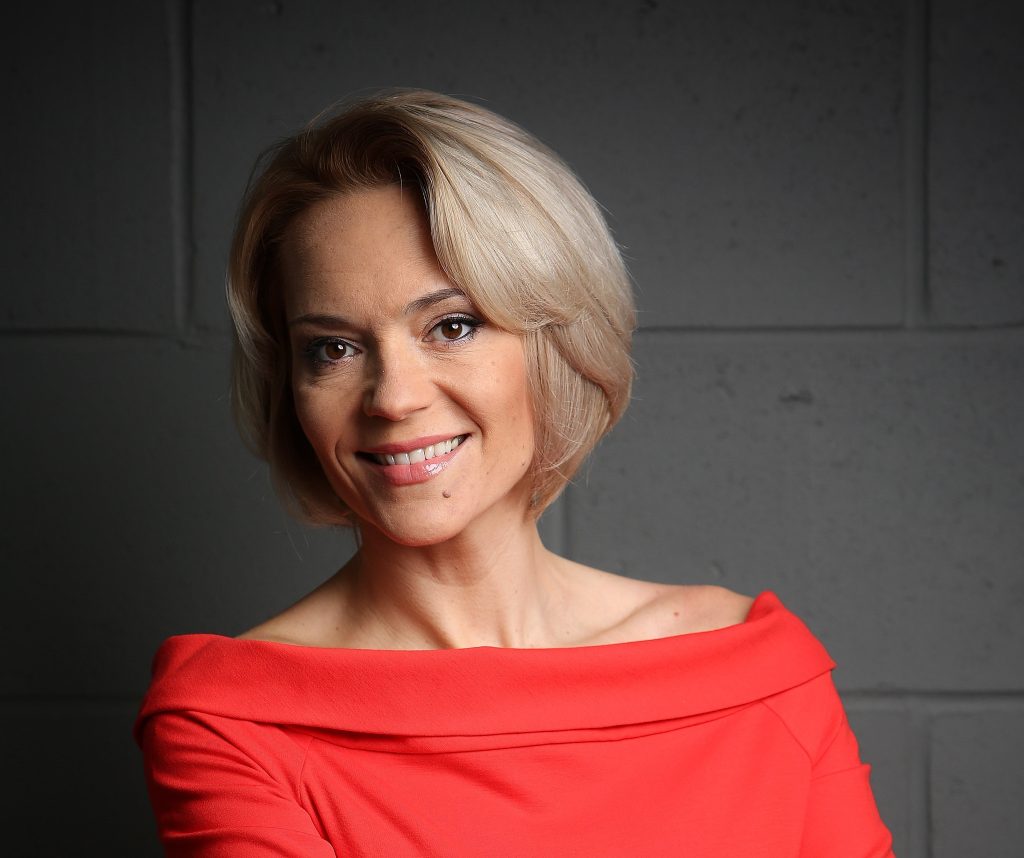
Joanna Socha: What was a breakthrough moment in your career?
Kasia Madera: I started my career working as a producer for Polish TV Wizja Sport. At one point, I realized I didn’t want just to produce, I wanted to work in front of the camera. I wanted to write; I wanted to read scripts. So I did a postgraduate diploma in journalism and landed my first journalism job at the BBC, and I’ve been working for the organization for 23 years.
Probably one of the first breakthrough moments for me was to be on air. My mom was a seamstress in haute couture, and she worked with designers who were doing London Fashion Week. I was able to get a few interviews with some of the designers, and that got me in front of the camera – and it took off from there.
I think the other breakthrough moment was when Russia’s full-scale invasion of Ukraine happened. I was deployed to the Polish-Ukrainian border, and I spent nearly three weeks reporting every day on the refugees who were coming through.
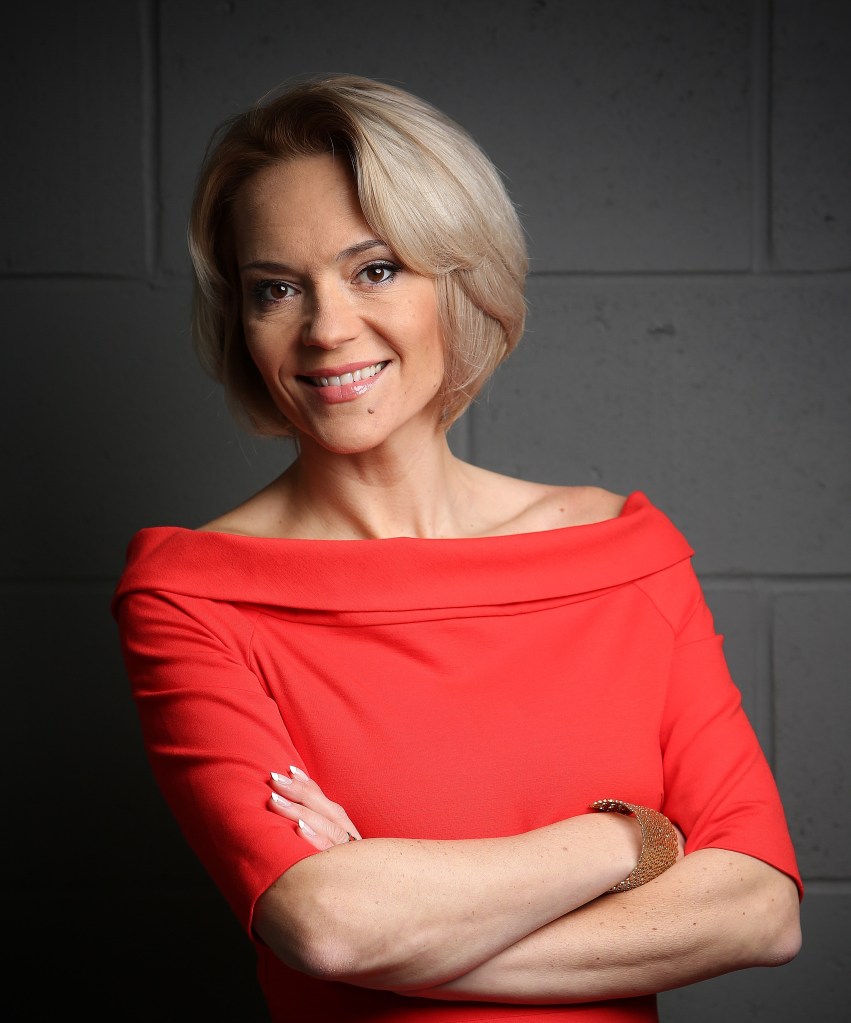
How is it to work for one company for so many years? Have you ever thought about changing something in your career?
Because the BBC is such a big broadcasting organization, there are a lot of opportunities within it. I started out as a producer and then began doing a bit of reporting. So far, I’ve had quite a few roles within the organization.
I worked in radio, I worked in TV, I’ve done online pieces. So it’s incredibly varied. Even though it’s one organization, there are so many different parts within it that it doesn’t feel like you’re doing the same job day in, day out.
And also, the job itself – we work in rolling news. You walk in and, honestly, you don’t know what’s going to happen. I mean, look at today! Look at the Israeli strikes on Iran! (edit. The interview with Kasia Madera was conducted on June 13th)
I’m going to be presenting a program at 6 PM local time. We know that Donald Trump, the White House, is going to have a press conference. We have no idea what’s going to happen. So you’re constantly being agile and adapting to what is happening. No day is the same.
I can imagine you cannot tell me what your typical day looks like.
I can’t tell you.
One morning, I was supposed to be presenting from 9 a.m., but as it turned out, at 9 a.m. I was on a train to Birmingham to cover a story. Or I came in to present from a BBC News studio, and instead, I was flying to Sweden because there was an attack on members of the public there.
I’m going to give you a sneak peek of one of our new studios (edit. Kasia shows her surroundings in the BBC office). This is a studio that we call BBC News Live. So we’ve got a standard, more traditional studio, where you sit down, you have autocue, you read scripts, you link into packages, you interview guests.
And this one is something completely new! We use it for our streaming platform. And basically, there’s no autocue. Everything is out live. And we’ve got lots of different sources. Whether it’s the Houses of Parliament, whether it’s something that’s happening in Iran, we’re always monitoring Gaza, depending on what we’re watching, what the newsroom is doing.
And it means we are right, slap-bang in the centre of the newsroom. So right there are our producers who work with me to help find guests, help formulate ideas, help with research, verify.
So you ask about my routine: it depends on what kind of program I’m doing. If I’m working the early shift, I can wake up at 4:00 in the morning and be present from 6:00.
Next week I’m going to be creating material for the launch of BBC News Polska. So I’m going to Warsaw to interview lots of Polish celebrities.
Oh, and we’re doing it in Polish, of course!
What do you think is the biggest misconception about working as a journalist on TV?
The biggest preconception is that you come in, everything’s written for you, and you’re just sitting there reading out loud.
The days of having an announcer who predominantly sits down and reads a script because they have a beautiful voice or whatever – that went 30, 40 years ago. That’s so dead.
And I think people find it surprising that I write what I read out. Or sometimes we just rip up scripts and ad-lib, because the news is moving too fast and you’re reacting in real time.
A really good example is now: we’ve got a second Trump administration. You are constantly reacting to what he is saying.
So you always need to be prepared to caveat, in case what he says needs to be verified. Often, you’ll know that he uses certain tropes, certain themes that you just know are not correct. So when he’s speaking, you can counter that and say, “Look, we know that’s not necessarily the case.”
The media landscape is evolving rapidly, and we can see social media taking over the narrative, with people actually looking for news there. How has it impacted your work in the last several years? Are you adapting to it in any way?
We need to make sure we’re where our audiences are. Increasingly, linear isn’t enough anymore to reach everyone we need to. People are using everything. And we also need to understand the demographics – who’s using what, and where.
For instance, some countries in Eastern and Central Europe use Facebook and Instagram more, whereas in Western Europe, Facebook is not really used anymore. It used to be X, but some people are leaving that platform.
The BBC started to use TikTok more when we realized the amount of disinformation happening there, especially after the full-scale invasion of Ukraine. So we moved onto it as, in part, we recognised the need to provide impartial, trusted news on the platform.
I’ve just come back from Dubrovnik, where I was hosting a panel for BBC Studios with other public-service media. We were talking about how, in an increasingly polarized Europe, and globally, audiences are becoming more divided.
In that context, the role of public-service media is to bring people together, to offer common ground. So it’s important for us to be everywhere.
We’ve got analytics showing where audiences are. We also have a growth team that constantly monitors the most searched-for questions.
For example, we were recently talking a lot about US tariffs. One of the main questions people on the internet were asking was: “What are tariffs?” So we made sure to offer content both for people who understand the issue and want deeper, more business-oriented news and for those who need a basic explanation.
It’s about never assuming knowledge.
I always think: how would I explain this to my 70-year-old aunt? And at the same time, how would I explain it to my 13-year-old son? You have to cover both ends – without being patronizing. It’s about finding that balance.
If your children wanted to pursue the same path, would you encourage them to do it, or maybe not?
I’d just be very open with them about the realities of working in this kind of role. The hours are long, the stories are difficult. It’s extremely competitive as well. That said, it’s incredibly fulfilling. It’s the most exciting job in the world!
So while I wouldn’t actively encourage it, I’d be honest about what this role offers and what it involves. I’d really just want them to do something they’re genuinely interested in.
And it’s hard. My 17-year-old is really into international relations, so I can already sense he’s heading in that direction. My 13-year-old – if he could be an influencer, that’s probably all he’d want to be ten years from now.
The landscape is going to change so much, that it’s impossible to say what kind of roles will exist.
So I’m just trying to find my feet as a parent – being as open-minded as I can, giving them perspective, encouraging them to do well at school, but also understanding the pressure young people are under today.
How do you unwind?
I read a lot. I try to do some running, though I’m not the most outdoorsy person. I mean, calling it “running” is probably optimistic. It’s more jogging, or fast walking. But I do like to be outside as much as possible. I’m hitting that age – I’ve turned 50 – so I know I have to look after myself and stay active.
I also love traveling. The thing with this kind of role is you’re constantly consuming the news. So I have to admit, I don’t switch off as much as I probably should. I listen to a lot of political podcasts, for example.
So it’s hard to fully switch off because things are always happening.
Interview by: Joanna Socha
Edited by: Joanna Socha, Phyllis Budka

 W Insight
Leave a comment