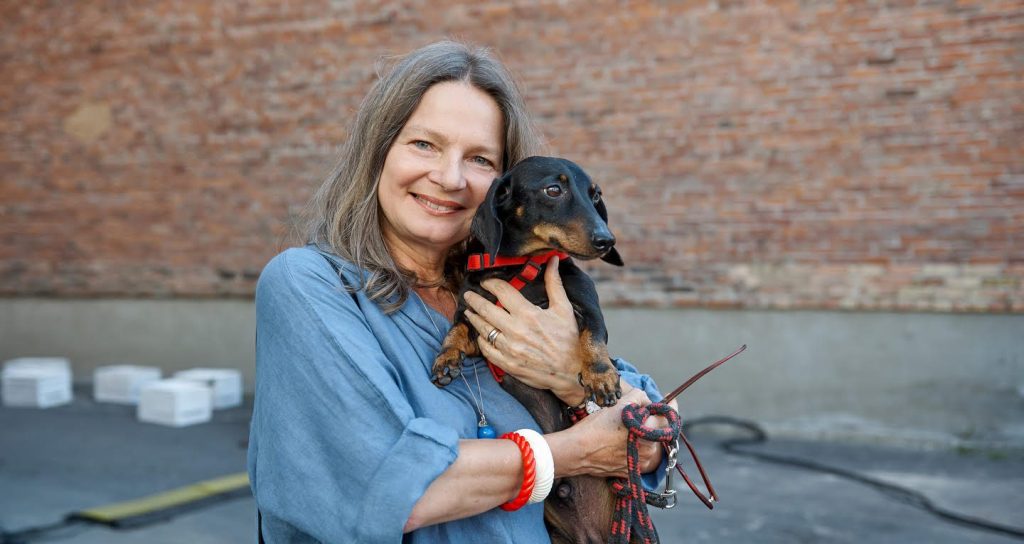
In an interview with W Insight’s Joanna Socha, Tuszyńska delivers a masterclass in writing. She’s brutally honest about the struggles—procrastination, financial instability, criticism—but instead of dwelling on them, she shares practical advice. And along the way, she introduces W Insight’s international audience to the world of Polish literature.
JS: Do you remember the moment you first felt drawn to writing?
I think I always knew I would write. I was a very quiet child, always buried in books. And if I ever wanted to say something, I did it on paper. As the years passed, I realized that I could express so much more through writing.
My mother was a journalist, and often took me with her to book fairs and meetings with authors. I remember traveling with my mother to Kazimierz Dolny, where near the Dom Pracy Twórczej (House of Creative Work) there was a grand home—still there, though now empty—of Maria Kuncewiczowa. I hadn’t yet read her books, but I knew a writer lived there, and I would watch her as she walked around.
She walked with such elegance—dressed beautifully, in a tailored suit, pearls, her hair perfectly done. She wore rings, spoke French and English, and guided her guests through her home. My mother told me, “She’s a writer.” And so I wanted to be one too—to write, to walk, to be graceful and speak different languages, and to be able to transport readers to different worlds.
I wrote many letters to Maria Kuncewiczowa. Later, when she was old and I was a very young writer, I even lived with her for a time. From there, everything happened quickly—I was praised for my essays in school, and won various competitions. In the beginning, I was intoxicated by the freedom writing gave me, the sense that I could do anything with words.Now, I understand what Kuncewiczowa used to tell me: writing is hard work.
Did this external validation at an early stage help you?
Definitely. And later in my career as well, though in a different way. For example, I am now known as a biographer and a prose writer, but I actually started with poetry—and now I’ve returned to it. But for years, I was more recognized for my prose, and my poetry faded into the background. So, this external recognition and praise are very important.
I’ve wanted to be a journalist for as long as I can remember, and I was discouraged by some people around me. I often heard, ‘It’s not practical; you won’t make any money from it.’
I never experienced anything like that. First of all, our home was filled with books. And my father was a well-known sports journalist at the time—everyone admired him. I remember going with him to the radio station as a child, and I loved it. My mother supported me a lot—she took me to the theater, and to book fairs, so I could meet writers. She encouraged my writing.
Even though my father would say sometimes that you couldn’t make a living from writing and that I should have a solid profession—preferably as a doctor, I didn’t really believe him. His mother had wanted him to become a doctor too, but he chose a different path because he loved radio. That was his big dream. He was truly passionate about his work, and I think I inherited that passion from him.
In your work, you focus on telling the stories of others—often strong, yet controversial people, who have paid a price for their courage. What’s your key when choosing your subjects?
I select figures who, at a given moment in my life, help me answer questions I am asking about myself. Let me give two examples. My first book about Isaac Bashevis Singer was written at a time when I had learned that my mother was Jewish. But I didn’t fully understand what that meant. I didn’t know how to process it, so I chose a writer—a guide to the world of Polish Jews—to explore that world, to understand its religion, traditions, language. In a way, I was looking for myself through him.
Irena Krzywicka is another figure I spent a lot of time with. I first helped her write Wyznania Gorszycielki (Confessions of a Temptress), which she dictated to me, as she was already blind and couldn’t write it herself. Later, after her passing, I wrote Długie życie gorszycielki (The Long Life of a Temptress), at the request of readers—mostly women—who wanted to know what had happened to her after the war, since her memoirs ended there.
In Krzywicka, I saw a strong, courageous woman who fought for herself and others. She had an extraordinarily open mind. In the 1930s, in a country deeply influenced by the Catholic Church—just as it is today—she campaigned for sexual freedom. She did not condemn homosexuality; she saw it as another form of love. She was ahead of her time in every way. And I deeply admired her—not just as a fearless activist but also as a court journalist, a mother, and the lover of Tadeusz Boy-Żeleński (edit. Polish writer). She practiced what she preached.
She was unapologetic, unafraid to ask anything—and she, in turn, could be asked anything. There were no taboos with her—not about sex, gossip, or anything else. I believe that’s what kept her young. When I met her, she was in her eighties, yet she had the spirit of someone much younger.
Despite the tragedies she endured—losing her husband, her son, and —ultimately— Boy, she remained resilient.
When I choose my subjects, I also seek to tell the story of an era. I look for figures whose lives span significant periods of history because, through them, I can also capture the world they lived in. Krzywicka was born in Siberia, grew up in Warsaw, and became deeply connected to the intellectual and cultural life of the 1920s and 1930s.
Through Vera Gran, I was able to “step inside” the Warsaw Ghetto and see what it meant to be a singer there. It’s one thing to be a seamstress or a doctor in the ghetto. But a singer? That raises ethical questions. And yet, the deeper I delved into her story, the more I understood her.
And now I realize that almost all of my books are about women. My first and latest books are about men, Singer and Romain Gary. But the rest? Mostly women. Even when I write about Bruno Schulz, I focus on his fiancée rather than him (edit. The Fiancé of Bruno Schulz). I tell stories about men through the women in their lives.
With Vera Gran, I wanted readers to ask themselves, just as I did—what are we willing to sacrifice to survive? How do our moral boundaries shift in times of war, when every step could mean life or death? What choices do we make under constant threat?
I believe that even though these books are about people from the past, they are incredibly relevant today. The questions I ask these characters, these women, are questions I ask in the present. And by trying to understand them, I’m also trying to understand myself—and hopefully helping readers do the same.
Do you have to like the people you write about?
Not necessarily. But I must be fascinated by them. Without curiosity, without passion, there’s no book. It always starts with admiration, with intrigue. But over the years it takes to write a book—two, sometimes four—things shift. For example, Gary no longer captivates me the way he did at first. Krzywicka, on the other hand, I admire deeply and always have.
And Vera Gran… she’s the most tragic figure I’ve ever written about. She stays with me. I think about her all the time. That book was written with overwhelming emotions.
Is there a way to stay empathetic without letting the weight of the subject overwhelm you? Is it even possible to maintain this kind of emotional hygiene—to detach, to keep some distance?
I think that’s a very personal thing. My temperament, my character—I tend to immerse myself completely in whatever I do. When I’m in the early stages of working on a book—the most exciting, absorbing phase—I dive in, body and soul. It’s hard to separate myself from the character, hard to gain distance. Their story stays with me constantly. The more tragic it is, the more it affects me and seeps into my everyday life. But I don’t resist it.
Later, though, when it comes to writing, creating the final shape of the book, a little distance becomes necessary. You have to take a step back because if you don’t, you risk writing something overly emotional, or too sentimental—and that doesn’t serve the text. The writing needs to be controlled, crafted in a way that makes the reader cry, not the writer. There were moments when I cried with my characters, but the reader should never see that.
Nowadays, there’s a lot of talk about setting boundaries with work—working, then stepping away, resting. I don’t do that. Honestly, I work all the time. And yes, that’s probably incredibly unhealthy.
Agata Tuszyńska
What’s your definition of rest?
I don’t really use that word. I love walking. I walk a lot, every day if I can, and always early in the morning to catch the sunrise. It’s usually an hour, maybe an hour and a half, and during that time, everything falls into place in my mind and soul. It calms me, but I can’t say I stop thinking about work. I come up with ideas, figure out what and how I want to write. It depends on what stage of a book I’m in—or if I’m between books, what I want to do next.
Talent or hard work. What’s more important?
Definitely work. And maybe a spark of something divine, a bit of talent. But without work, there’s no chance of getting on the right track. It’s simply impossible.
That’s why discipline is so crucial in this kind of work. Writing every day. Because if you write every day, you build fluency. I’ve experienced this myself. There were times when I’d go a week without picking up a pen. And getting back into it afterward was hard.
What can you do, practically, to improve your writing skills?
Reading is the foundation of writing. It develops a kind of ear for language, a sensitivity to rhythm and flow. And it’s not just about reading prose, poetry is just as important. I’m not saying anything groundbreaking here. Ryszard Kapuściński said the same thing. Poetry enriches language. It teaches metaphor, imagery, the craft of shaping words into something powerful.
Look at the great poets—Miłosz, Herbert, Różewicz, Szymborska, Lipska, Norwid, Mickiewicz. We have so many extraordinary poets in this country (edit. Poland). If you read just one poem a day, that’s 365 poems a year. And I promise, that alone will change the way you think, how you write, how you see language. It forces you to pause, to step out of this fast-moving world for just five minutes. And that does something to the brain. Poetry is a metaphor, image, scene—it’s about how language is used, how it breathes.
I think all artists do this in their own way. Lately, I’ve been spending more time than ever with musicians, and what they go through—it’s grueling. Pianists practice four hours a day, until their fingers stiffen. Writing is no different. If you don’t do it every day, you lose the muscle. Kapuściński used to say, “Write one good page a day. That’s enough.” Imagine—one good page a day, and by the end of the year, you’d have a book.
You’ve already touched on discipline and persistence, but do you have any practical tips on how to deal with procrastination, discouragement, or even writer’s block?
I don’t know any other solution than simply sitting down at your desk—every single day—and trying to write. Even when it’s not going well. Even when you’re not writing about what you planned to write that day. Even if you end up writing something completely unrelated—or even about the fact that you can’t write at all.
The key is to sit down and write anyway. That’s how you build discipline. Because it’s so easy to grab your phone, check Facebook, then Instagram, then decide to do the dishes. And then… well, you’ve lost half the day. I struggled for years to focus and write at home.
Agata Tuszyńska
That’s why I often went away to writers’ residencies—places designed for uninterrupted work.
Have you ever faced harsh criticism of your work? And how do you deal with it?
Of course. Every writer does. My writer friends always say: “Don’t read reviews.” Because reviews can be toxic, and you never know how they’ll affect you. Paul Auster, whom I was friends with for years when I lived in New York, told me that he and his wife, Siri Hustvedt—who’s also a fantastic writer—never read reviews.
Do you read reviews?
Sometimes. Not because I go looking for them, but occasionally, someone sends one my way. And yes, I do come across negative ones. But with time, you realize—you can’t please everyone. What really stings are reviews that are unfair or personally malicious. But I’ve learned to accept that not everyone will like what I do. Anyone who chooses a public-facing profession—whether it’s writing, acting, or music—puts themselves out there.
Let’s talk about the financial side of writing. Earlier, we mentioned how many people are discouraged from careers in journalism or literature because of financial uncertainty.
And they do have a point. I believe you can’t make a living from writing alone—unless you’re selling books in huge numbers, over 100,000 copies or more. That’s rare.
I don’t know many writers who survive on book sales alone—except for bestselling authors, crime novelists, or a few big names like Remigiusz Mróz or Olga Tokarczuk. Most writers do something else alongside writing. Many work in academia, teach creative writing or literature. Even in the U.S., where the market is larger, most authors rely on university positions or other jobs to support themselves.
Interview by Joanna Socha
Agata Tuszyńska’s website
All photos for this story has been provided by Agata Tuszyńska.


 W Insight
Leave a comment