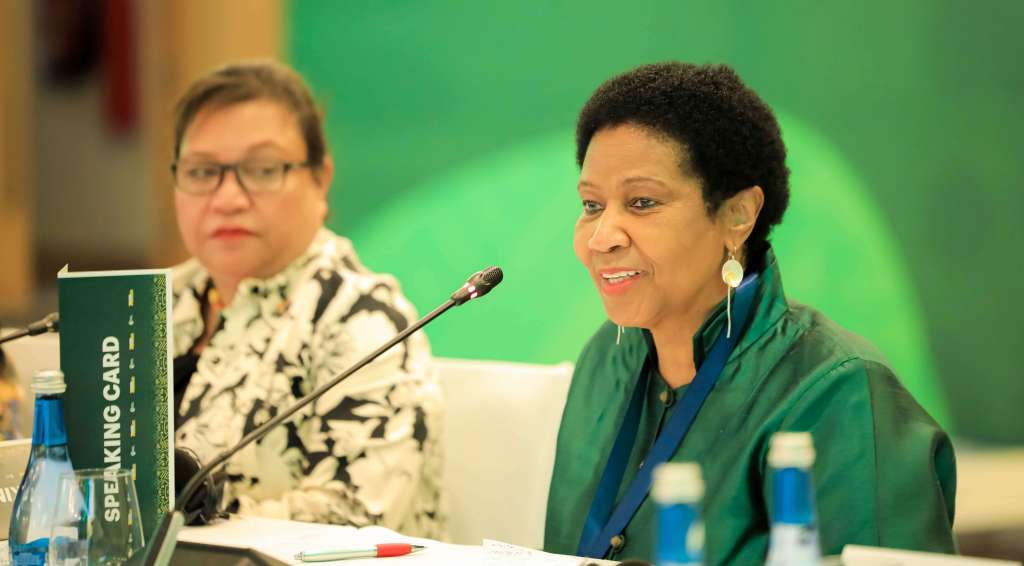
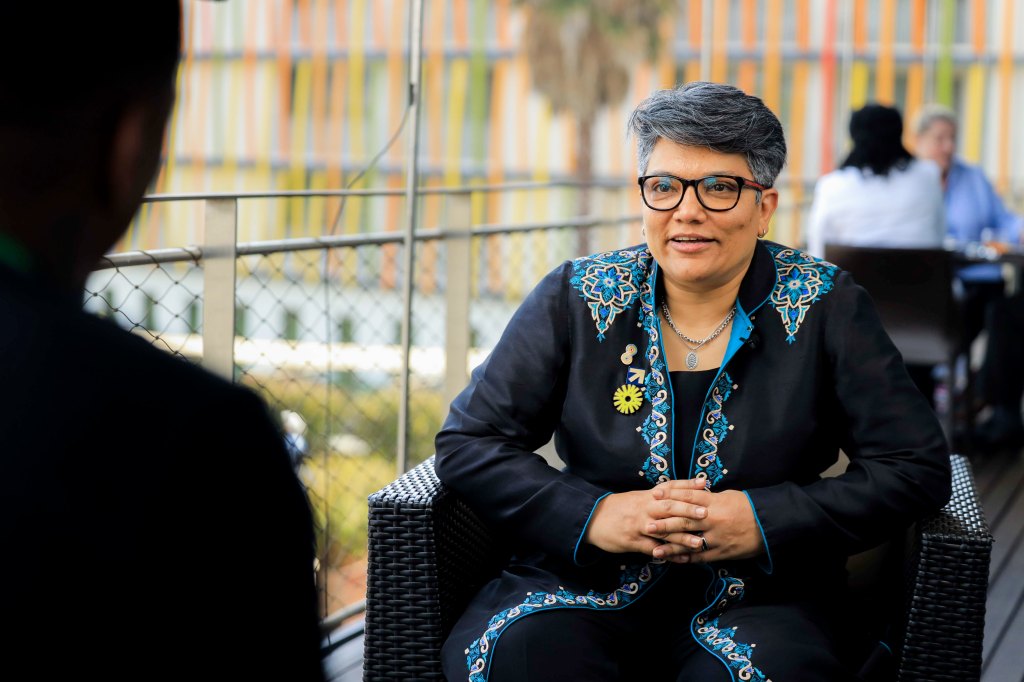
The interview was conducted by Joanna Socha during the Women Deliver conference in Rwanda in July 2023.
From a very young age, you blazed the trail for many underrepresented groups. How did you find your voice and the power within yourself to take bold actions?
When I was growing up, apartheid was in your face. You could not avoid it. In fact, if you were not an activist against apartheid, something must have been really wrong with you. I belonged to organizations that were very active in that area; our lives simply rotated around fighting apartheid. And there was a time when I didn’t think any other life was possible. When I look back, I can see how your environment can totally take over your whole life, your whole thinking.
In my case, I was lucky because my parents served as good examples: my mother, for instance, was a health activist. Then I went out with young people of my generation, and we had to deal with issues of our age group. For us, the entry point was education because we were rejecting the kind of education we were getting. It was very natural for us, and it’s tough to explain. It’s almost like you get up in the morning, brush your teeth, eat, and go to the community to fight for the causes you believe in.
We live in a very volatile world right now. What would be your advice to emerging leaders in politically unstable countries who are understandably afraid to speak up, but also to people anywhere else in the world who struggle to find the courage to criticize the status quo?
A war in one part of the world can easily affect everybody far away. If you say you don’t want to be involved, the war will find you. You will run out of food, or you will have inflation. Or there can be migration challenges.
Suppose you are unwilling to stand up to support someone in a difficult situation. In that case, you need to be careful because this could happen to you one day, and there may be no one to support you. Engagement and solidarity is something you have to learn to give, so that there could be a chance for you to receive it when you need it. It must be a part of your life.
And, of course, at the institutional level, if you are a small country, it can be hard to stand up to, let’s say, Russia. But it’s important to protest something anyways, through multilateral organizations and other institutions where your little voice also counts.
In one of your interviews, you mentioned something that really spoke to me: it’s important to be happy about other people’s victories. Could you elaborate?
Those of us who were born before social media are lucky because we had a little bit of a different introduction to public life. Many of the things we fought for tended to be long-term and it was challenging to see victory and achievement. And in order for you to gain the strength to keep on going, you had to find victories somewhere around you. And if that victory is for someone else, it should uplift you as well because you have similar goals.
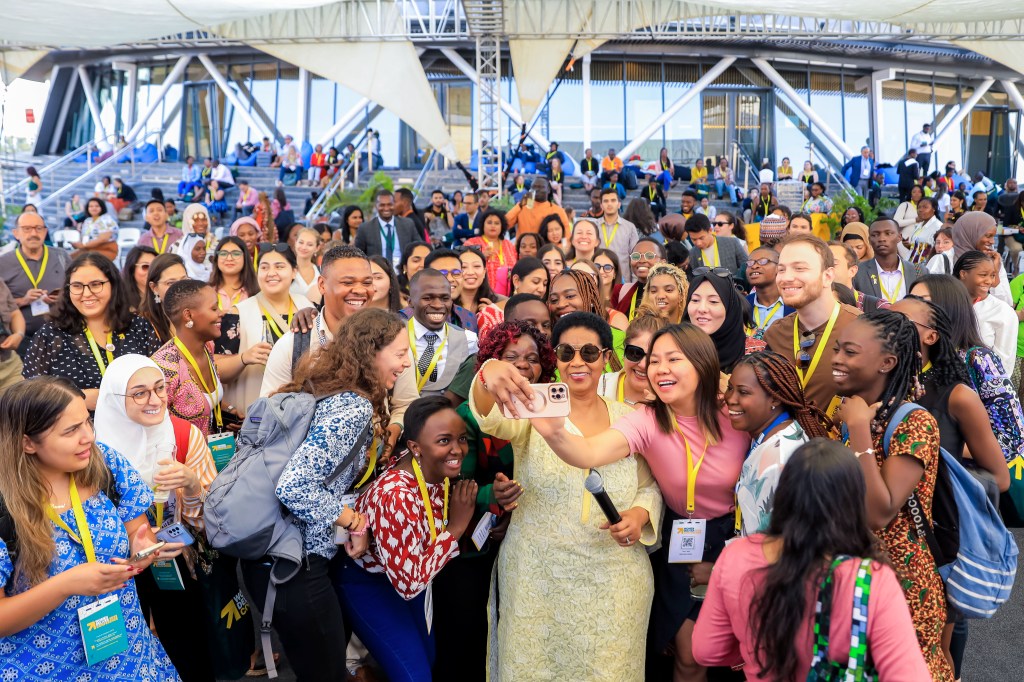
Again, in a fight for a bigger goal, solidarity is essential. You don’t only fight for what is meaningful to you. You fight a cause for humanity. I mean, we’re here,at this conference, we are all concerned about homophobia, we are worried about racism. We don’t know all Black people in the world. We don’t know all LGBTQ people. But we stand for the principle. And if someone else gets a breakthrough and something good happens to them, you feel it’s worth it.
Are there any career-related decisions you regret?
Even though I don’t think I would have worked very well in South African politics, with the team that took over after President Thabo Mbeki (edit: president of South Africa from 1999 to 2008; Mlabo-Ngucka served as Deputy President of South Africa from 2004 to 2008), I now think I probably should have stayed, even in the background. I should have stayed for times like now, when things are so tricky and you want to get involved, but you cannot anymore. You sort of have already put yourself in a situation where it’s much more challenging to be in the thick of things.
I shouldn’t disengage. Because once you jump out to take a break or to think about things, it’s difficult to get involved again.
Let’s touch on the HeForShe campaign, which was launched during your time at UN Women. It was very popular, particularly with people like Emma Watson, who was the face of the campaign. Looking back,do you see progress in the space of men advocating for women or was HeForShe just another one-off action?
Well, it’s still there, and it’s going through evaluation. HeForShe helped bring to the UN’s attention the role and the responsibility of men in the struggle for gender equality. But we didn’t consider that some of the powerful leaders, men, who got involved, did it primarily because they just could not say no in the public eye. Even though their heart was not really there. Also, what has been missing and what I think we should invest in, is the mobilization at the grassroots level. Because just as much as you need those who have the power and authority to actually implement changes, there’s a lot of power in the people on the streets. Many of these people are here (edit. Women Deliver conference); it’s the grassroots organizations focused on women. We know how to reach out to women’s organizations. And men need to have grassroots organizations the way we do. We still need to learn how to engage them. Because in my view, a feminist movement of the future will have to be a movement of both men and women. Women can’t (and it doesn’t make sense for them) talk to themselves about things that are important to us. We should involve everyone.
What do you like to do in your free time? How do you recharge your batteries?
I now have many grandchildren in the family. I like to spend time with them. It’s the most exhilarating thing. They connect with you so innocently, and they will say anything they want to say. They don’t have time for your titles, you’re just a grandma that they push around.
You’re probably their favorite person to play with.
Absolutely. As long as they don’t make me run.
Interview by Joanna Socha
Edited by Diana Asatryan
WD Conference photos provided by Women Deliver
 W Insight
Leave a comment