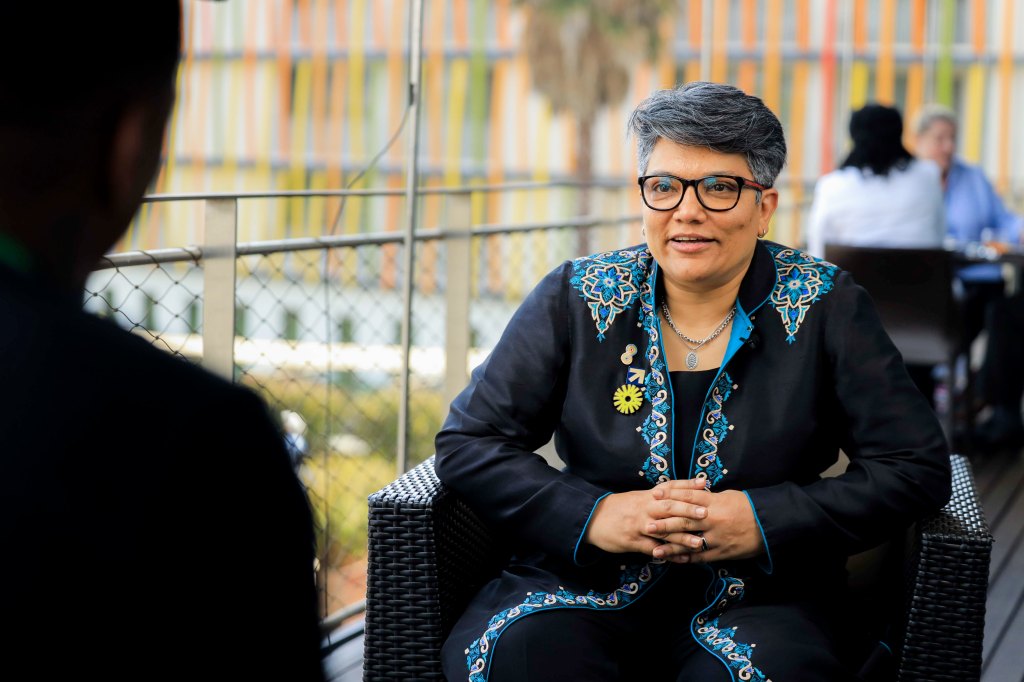
We are meeting in Kigali during the Women Deliver 2023 conference. You have certainly heard this question many times: Why did you organize this conference in Rwanda?
We considered three things when we thought about hosting it in Kigali. One was that we never had this conference in sub-Saharan Africa, and it was time to bring it to the continent. And Kigali has the facilities. Second, we were concerned about accessibility from a passport point of view. We know there are inequalities in the world, and with some passports, it takes you six months or even a year to get an appointment to get a visa to certain places. So, we wanted to make sure that it’s an accessible location no matter which nationality you have. And Rwanda promised visas to all nationalities, even people holding refugee documents. The third reason is we wanted the world to learn from Rwanda. The country still has many issues, but what it has been able to achieve in terms of gender equality over the last 30 years has been absolutely incredible! And to me, it showcases that even a low-income country that has gone through massive trauma nationally and started with a very low base can still achieve a lot when there is political will, drive, and investment to do it.
Has the difficult history of Rwanda, particularly the aftermath of the genocide in 1994, played any role in you choosing this place for the conference?
Rwanda’s history in itself did not. But the country’s response to its history absolutely did. And I think that response goes hand in hand with what I just said about the political will to move towards gender equality. I often think that the connection between respecting human beings, moving beyond the trauma, and doing the type of healing that Rwanda has been able to do, are very connected with also treating every human being as equal and deserving of all opportunities.
You joined Women Deliver as a CEO in April 2022. What are the most important goals on your agenda?
As you know, Women Deliver itself went through a lot of difficult reckoning in 2020 and had been going through a transformation process (edit. In 2020, Katja Iversen stepped down from Women Deliver amid accusations of racism and harassment of WD staff). So first and foremost, one of my goals when I joined as CEO was to make sure that the team at Women Deliver felt heard, felt a sense of optimism and change, and that we would continue the difficult conversations about what type of organization we wanted WD to be. But I also wanted to turn those conversations from internal reflections to action. So we decided to look at our work and try to transform it to be more decolonial and anti-racist. The second goal – we needed to change our narratives. International development has narratives we look at uncritically and think are okay. We use big technical words to present ourselves as technical experts who know more than the populations we’re trying to address. We use language that creates a sense of ownership and belonging of people. We used to say, “our young leaders,” as if Women Deliver owned them. And they are terrific leaders who, with or without WD, would have done amazing things in their lives. And then the third goal, which is the one that we’re working on now and will take the longest to do, is how do we transform our business model. International Development’s business model has been very northern based, very exclusionary of people from other parts of the world. But more than that, the ways that we value expertise and what we write in our job descriptions, the types of experiences we want people to have, are very privileging of those that have had opportunities in the global North and very exclusionary of those that haven’t had those. So that is something we’re continuing to work on.
You come from Pakistan, where, as I read in your bio, you focused on including girls and women into exclusively male development projects, which “taught (you) a lot about what not to do.” Can you provide an example?
I think we are often too focused on very performative and, in the end, inconsequential outputs. One of the first projects I worked on was a horticultural development initiative, where the goal was to include more women into it. So, the team was trying to recruit women, but how it did it, in my view, needed to be revised. They thought, well, what’s a woman’s role? And they came down to: “Maybe we could teach the women to preserve the surplus fruits and vegetables that came out.” So literally, this project was going around for five years, teaching girls and women how to make jam and ketchup. I don’t want to belittle it that much, but that was pretty much what it was doing. What it taught me not to do was that these sorts of “women’s roles” that men were defining weren’t really empowering women. But what it also taught me, which I hadn’t even thought about, was that in order to work with women, you need to hire women at more senior levels. It’s important to understand that in Pakistan, which is a very conservative society, men cannot interact with strange women, especially in rural areas. You can’t sit and have a face-to-face conversation. There are all sorts of social norms of seclusion and segregation around it. So, what they had to do, and at that time they had no female staff, was recruiting female staff in very rural areas where women often had never had formal employment, to do all this recruitment work. The impact of that first cohort of women workers, who were working formally in that sector, were getting salaries from bilateral agencies was probably the biggest impact of that project. And that was transformative.
I think this notion that we have to do good and that “good” has to be concrete, is wrong. It makes you count jars of jam. You can’t count the aspirational transformation of a girl of ten, when she sees her mother doing this job and parents realizing: “Actually, if we keep her in school, maybe she can get a job like that, too.” And her aspiring to do that, that can’t be counted.
And that’s part of the problem that we have in international development. We feel like we have to do action and that action has to have immediate results. And that brings us down to these actions which in the end are inconsequential.
I wanted to touch upon the Katalin Novak controversy and feminism (edit. Hungary’s President Katalin Novak, known for her conservative views, spoke during the opening ceremony at WD, encouraging women to have children, which sparked controversy among some participants and pushed WD to release a statement distancing themselves from the politician.) In the context of conservative values, I wanted to ask you: Am I a “good enough feminist” if I’m Catholic, I believe in family, and although I don’t impose my values and beliefs on anyone else, in an ideal world, I wouldn’t want to have an abortion?
Do you feel you’re a good enough feminist?
I do.
Then you are to me. The key is, do you want to see every girl or woman being able to achieve their true potential without barriers and hindrances, based on what they want, not on what you think they should want, what society wants them to have, or what their families want to have? You can hold all sorts of beliefs true to yourself. Maybe you would never want to get an abortion. Perhaps you would never want to be in a same-sex relationship. Maybe you would not entertain the notion of changing your gender appearance in any way. But as long as you respect the rights of others to do it, then you are a feminist, in my view.
Interview by: Joanna Socha
Edited by: Phyllis Budka
Featured photo of Maliha Khan was provided by Women Deliver and presents Maliha Khan during one of her interviews at the Women Deliver conference in Kigali. It’s not a photo from the interview with Joanna Socha.
 W Insight
Leave a comment