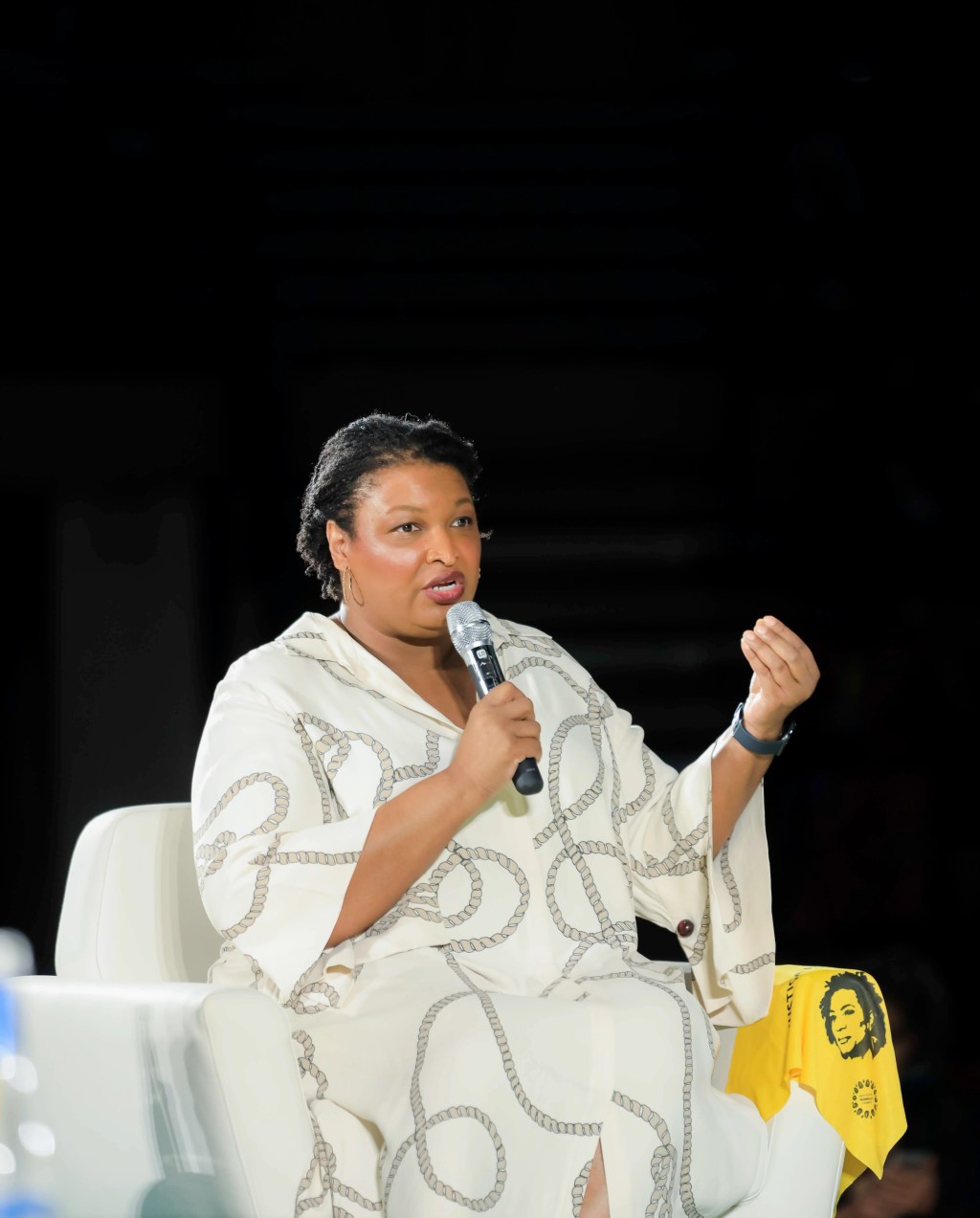
During the Women Deliver 2023 conference in Kigali, Rwanda, Abrams sat with Joanna Socha to discuss:
- the rise and fall stories from her career
- working on a common goal with the “other side”
- whether she will run again
You are known for galvanizing thousands of people to take action, increasing voter turnout in Georgia in the 2020 US presidential election, and U.S. Senate elections, which helped Democrats win. Do you remember the first moment in your life when you realized “I have a voice. I want to use it.” If yes, could you tell us more about that moment?
I grew up with parents who were very active in social justice issues, and they raised us to believe that our responsibility was to speak up for other people. When I was a very young student in elementary school, I remember I spoke up for a friend who was being mistreated because of a language barrier. I also remember when I was invited to speak at the March on Washington’s 30th anniversary in 1993. I was 19 years old, and I stood before a crowd of more than 50,000, and they listened. And I think that as much as I spent my childhood engaged in trying to help those around me, it was the first moment I realized that my world could be bigger than the communities I was a part of, and that I had the real opportunity to speak to a broader audience about what I thought should be done.

“We are writing the next chapter of Georgia’s future, where no one is unseen, no one is unheard and no one is uninspired,” you said in 2018, when you won the Georgia Democratic primary for governor. Who are the unheard, uninspired and unseen people today?
Let’s start with unseen, marginalized communities, including the disabled community. These are often left out of policy conversations. They sometimes receive directed services, but rarely to the level and with the depth that they need. Second of all, communities of color. Even in nations where there is attention to diversity, there are always minority communities that are sidelined or marginalized. We know that the LGBTQIA community is under attack across the globe. And so part of my concern is that any community that is marginalized, that is denied the full measure of their humanity, deserves representation and deserves a voice. When you think about the uninspired, I would say that often we chide young people and say they’re apathetic, and it’s rarely apathy. It’s much more disappointment and despair. They are both hopeless and they feel helpless. That’s why part of my mission is to make certain that they know that their voices do matter, that if they are engaged, change does come. It’s going to be slow. It will often be reversed by people who don’t want that change to be possible, but that the inspiration piece is to believe that it’s still worth the effort.
I’m from Poland and although we can see that the voter turnout among young people has increased in recent years, there are those who are now turning to the right-wing populistic narrative, and they really see hope in the radical movements. Why do you think that is?
Inspiration often comes from acknowledging a person’s pain. And even if the person offering the acknowledgement does not have your best interest at heart, that goes to the point of being seen and believing that people want you to have something.
Unfortunately, when those on the side of good are silent, those on the side of wrong are louder and that volume can be very persuasive.
And that’s why I push back against the idea of apathy. Apathy presumes that you don’t care. Young people care desperately. They want someone to see them. They want to be heard. They want to know more is possible and they are being assailed by the climate crisis, economic crisis, a social upheaval that is transforming the world around them. And if the only person offering a narrative framework, offering a roadmap, is leading them down the wrong road, they still want to move. And so our responsibility is to offer a counter narrative that is just as loud, just as compelling and just as persistent. Some will tell a lie a thousand times until it sounds like the truth. And others will tell the truth one time, and if you don’t agree with them, they stop talking.
And instead, we should be just as aggressive, just as persistent! And for me, that follows across almost all of the work that I do, whether it’s voting rights, social justice, or ending poverty: we have to be as loud and as intentional. But more importantly, we have to listen, because what works so effectively in a populist movement is that it gives you someone to blame, but it also gives you a sense of what’s possible. And even if that possibility will never be realized, the fact that they offer you hope, offer you a vision, it is much more compelling. And that’s unfortunately what’s happening around the world.
Have you ever succeeded in convincing someone from the opposite side to work with you on a common goal?
Yes, I have. One of my jobs, when I was in the state parliament, was to work with the “other side”. And one thing I do differently than many is that I don’t try to make you believe what I believe. I have a very specific upbringing, a very specific set of beliefs, but we don’t have to believe exactly the same thing to want the same outcome. And so I worked with a group of people in the United States who do not believe in environmental issues. They do not believe climate change is real. But I needed their help on environmental legislation. We needed to protect our community and protect our water. I went to the head of the opposition. That person, she had nothing in common with my progressive values. But I pulled her aside and I said: “Look, you and I don’t agree on the environment, but we do agree that people should have the right to control their land. And if we both agree on that, can we work together?” And she and I were able to successfully defeat the legislation.
Who was she?
So I chose not to disclose that. Because a part of what happened is that I also don’t feel compelled to get public attention for what we did together. Sometimes it’s hard to work with those you disagree with, if there are consequences for being there. So we both worked to defeat the legislation, but for different reasons. And so to your fundamental point – I don’t need to convert you to believe everything I believe. My parents are ministers. So let’s think about it. Would I ever convince you to change your religion? Is there anything I can tell you after…how old are you now?
I’m 33.
Is there anything that I can tell you after 33 years to change your religion?
I don’t think so.
So why do we think we can change someone’s beliefs? But I could convince you to work with me on something. If we both have the same outcome in mind, we don’t have to have the same belief that drives us.
And I think one of the risks that we take is that we spend so much time trying to convert a person’s beliefs that we forget to convince them about our actions.
Coming back to the gubernatorial elections in 2018, when you lost by just two points to Brian Kemp. It didn’t discourage you from continuing your efforts. Instead, you started a Fair Fight Action – the campaign that aims to fight against voter suppression. What gave you the strength to continue your work?
The first responsibility is to know why you are doing whatever it is you’re doing. If I wanted to become governor simply because I wanted the title, then not winning meant that I should just stop. But the reason I ran for office was that I wanted to help people and this was a job that would have allowed me to help. And because I remembered why I wanted to do the work, not getting the title, while painful, was not crippling, and so I could still focus on the ultimate goal.
What I tell people is: know why you want to do it. And when you don’t succeed, that doesn’t mean that the whole world disappears.
The second concrete advice is that you are more than the things you try. Often, we focus on the jobs we ask for or the titles we seek or the status we seek. That’s only a part of who you are. There are people that you know and love who love you, who don’t care. You shouldn’t care either. You should want, but it shouldn’t define you so much that if you don’t get it, you are completely decimated.
And I think for so many of us, especially in this time and in this age, we become convinced through social media that we’re only the thing people see, that we’re only the title we are ascribed, that we’re only the last success that we’ve had. I was a whole person before I ran. I’m a whole person when I’m done. And if I win, that’s one more part of who I am. But I am not less of a person because I didn’t get it. And I think that’s the piece that we often lose sight of. We think that we are diminished by not winning. I believe that we are diverted.
I’ve not won twice. And the first time I didn’t win, I created three national organizations that have done incredible work. This time I’m doing work on an international level and I’m still doing a lot of domestic work because while I think the title and the job and the platform matters, it does not matter more than the work itself. And my responsibility, and this is the third piece of advice – when you don’t get the thing you want, find another way to contribute.
Are you going to run again?
I don’t know what I will run for. I will run for office again. I don’t know when. I don’t know which job. So, nice try!
But I believe that political power matters. And I believe I’m an effective political leader. I also know that I’m a writer and an entrepreneur. I get to do international work on democracy. And so there are many other ways I can contribute. That is one way I would like to contribute. And if I have the chance to do so, I will. And if I don’t, I’m still wholly who I am.

Tell us a little bit about the romance novels side of you.
I’ve written a total of 15 books, including eight romance novels. I have always wanted to tell interesting, complex stories about women that we never really got to hear about, especially women of color. And I found that I could talk about complex conversations and make people fall in love. I wrote books for about ten years, and then I got a bigger job in politics, and started my next book Lead from the Outside, which is my memoir-slash – leadership book. I then wrote two legal thrillers, exciting political conspiracy theory books. And then I wrote two children’s books; I co-authored a book on business and helping people; and I also wrote a book on democracy and voter suppression.
I like lots of different things, and I’m privileged to be able to explore different topics. And I think that goes back to one other piece of one of the questions you had. I always say I have backup plans. One of the things to do, if you face loss, is to have a backup plan. I’m never defined by one aspect of who I am, and I can raise or lower what I’m doing based on what is before me, but I’m never lost.
What book would you recommend for the Summer?
My latest novel, called Rogue Justice. It’s about a young woman who is a clerk. She works for the Supreme Court, but she has the least amount of power, and she suddenly has to save the world. So the question is, what do you do when you have responsibility but no real power? It’s a lot of fun.
Interview by: Joanna Socha
Edited by: Phyllis Budka
About Women Deliver:
Women Deliver is a leading global advocate that champions gender equality and the health and rights of girls and women, in all their intersecting identities. Our advocacy drives investment – political and financial – in the lives of girls and women worldwide. We harness evidence and unite diverse voices to spark commitment to gender equality. For more information, please click here.



 W Insight
Leave a comment